Explore key tools, smart features, and expert insights...
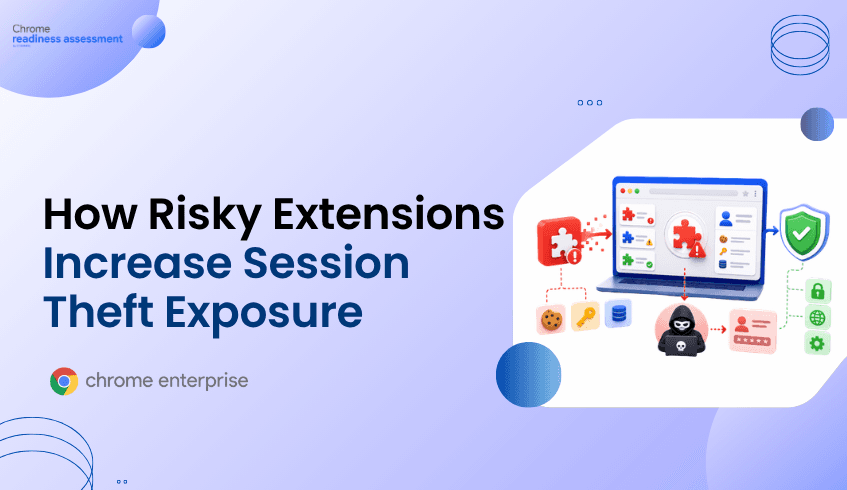
Risky browser extensions can increase session theft exposure because they operate inside the same environment where users access enterprise applications, SaaS platforms, and authenticated browser sessions. Even when an extension is not obviously malicious, broad permissions, unverified installation sources, or weak governance can create browser-layer risk. Browser Insights helps security teams identify unverified extensions and device-level exposure across the browser fleet. Chrome Enterprise Premium provides the enforcement layer, while CEP Accelerator helps teams prioritize where to strengthen browser security first.
Risky extensions matter because browser sessions have become one of the most valuable targets in enterprise security.
When a user signs in to a business application, the browser maintains session state so the user does not need to reauthenticate on every page. That session context may include cookies, tokens, application access, and authenticated workflows. Attackers target this post-login state because stealing or abusing a valid session can help them bypass the login step entirely.
Extensions run close to that environment.
A browser extension may interact with web pages, read or modify page content, access browser activity, or request permissions that affect how it behaves across websites. Google’s Chrome Enterprise extension management guidance notes that admins can evaluate and manage extensions based on the permissions they request.
That permission model is what makes extension governance so important. A productivity tool with limited access may be low risk. An unknown extension with broad access across sites may create a much larger exposure point.
Extensions can increase session theft exposure by expanding what runs inside the browser and what has access to browser-based activity.
In a typical session theft scenario, attackers are not trying to defeat MFA directly. They are trying to steal or misuse the authenticated session that exists after MFA is complete. That can involve malware, phishing, unsafe domains, compromised endpoints, or risky software running near browser data.
Extensions can contribute to this risk in several ways.
An extension with broad host permissions may be able to interact with many websites. An extension with content access may observe or modify pages users visit. An extension installed from an untrusted or unverified source may not have gone through the same review process as approved enterprise tools. An extension that changes ownership or receives a compromised update can also become risky after it has already been installed.
Google has also highlighted the broader session theft problem through its work on App-Bound Encryption, which was introduced to improve protection for Chrome cookies on Windows by tying encrypted data to app identity. Google’s security team explained that infostealers take advantage of weaker cookie protection models by attempting to access browser data as the logged-in user.
The lesson for enterprises is clear: session protection is not only an identity problem. It is also a browser posture problem.
Unknown and unverified extensions are risky because security teams may not know what they do, what permissions they request, or where they are installed.
Users often install extensions for convenience. They may need a PDF tool, meeting helper, screenshot utility, AI assistant, grammar checker, coupon tool, password helper, or productivity add-on. Some of these tools may be legitimate. Others may request more access than the business is comfortable allowing. Some may be installed only on one device, while others may spread across teams.
The problem is visibility.
A security team may have strong identity controls and endpoint protection, but still lack a clear view of browser extensions across Chrome, Edge, Firefox, Brave, Vivaldi, and Opera. Without that inventory, unknown extensions can become policy blind spots.
Google’s Chrome Enterprise Security Blog has emphasized that poorly designed or malicious extensions can compromise data integrity and expose sensitive information, making visibility and control important for organizations.
For session theft risk, that visibility matters because unverified extensions can sit inside the browser environment where authenticated work happens every day.
MFA protects the authentication moment. It does not automatically protect every authenticated browser session that follows.
Once a user completes MFA, the browser receives session cookies or tokens that keep the user signed in. If an attacker can steal or misuse that session material, they may be able to impersonate the user without needing the password or second factor again.
That is why browser security has become a critical part of identity protection.
Google’s recent work on Device Bound Session Credentials is another example of the industry shift toward protecting sessions after login. The technology is designed to help combat session theft by binding session credentials more closely to the device.
For enterprises, this reinforces a practical point: identity controls and browser controls need to work together. MFA reduces credential abuse. Browser posture helps reduce what can happen after authentication.
Traditional security tools often focus on endpoint events, identity logs, network traffic, or application access. Those signals are useful, but they may not show enough browser-specific context.
For extension governance, security teams need answers to questions such as:
Which extensions are installed? Which devices have unverified extensions? Which browsers are affected? Which extensions have broad permissions? Which devices combine extension risk with outdated browsers or unsafe domain access?
Without those answers, teams may only find risky extensions after a user reports a problem, an audit reveals a gap, or an incident investigation begins.
That is too late.
Extension risk should be visible before it becomes part of a session theft chain.
Chrome Enterprise Premium helps organizations bring enterprise-grade security controls directly into the browser, where extension and session risk occur.
For session theft exposure, this matters because the browser is where users authenticate, access applications, interact with data, and maintain active sessions. Chrome Enterprise Premium strengthens browser security with threat protection, data protection, centralized management, and secure enterprise browsing controls.
It also works alongside Chrome Enterprise extension management capabilities. Admins can use Chrome Enterprise policies and the ExtensionSettings policy to manage extension behavior, including allow, block, and installation settings.
This gives organizations a path from extension discovery to browser-level enforcement.
Security teams can identify risky or unverified extensions, define which extensions are approved, restrict extensions with unacceptable permissions, and reduce the chance that unmanaged add-ons operate inside enterprise browser sessions.
Browser Insights helps security teams see extension risk across the enterprise browser fleet.
It surfaces browser and extension details across Chrome, Edge, Firefox, Vivaldi, Brave, and Opera. This includes installed extensions and related browser information that helps teams understand where extension exposure exists at the device level.
For session theft exposure, the most relevant signals include unverified extensions and browser version status. Outdated browsers may indicate weaker protection against known session theft mechanisms, while unverified extensions can represent additional browser-layer exposure.
Browser Insights also supports device-level drill-down, allowing teams to investigate specific machines where risk is elevated. This is especially useful when extension risk overlaps with other browser signals, such as restricted or non-HTTPS domain access.
The goal is not to treat every extension as malicious. The goal is to identify which devices and browser environments need review before session risk becomes harder to control.
CEP Accelerator helps teams turn Browser Insights findings into a prioritized Chrome Enterprise Premium deployment plan.
It is a planning and visibility layer. It does not enforce policies, detect attacks directly, or automate remediation. Instead, it helps connect observed browser risks to the relevant Chrome Enterprise Premium capabilities that can reduce exposure.
For risky extensions, CEP Accelerator helps teams understand where extension exposure should influence enforcement priorities. A device with unverified extensions, outdated browser versions, and unsafe domain access may deserve faster attention than a device with only a lower-risk finding.
That prioritization matters because browser risk is rarely evenly distributed. Some users, departments, or devices may carry more exposure than others. CEP Accelerator helps security teams focus deployment planning where it can have the greatest impact.
Security teams should treat extension governance as part of session security.
That starts with visibility. Teams need to know which extensions are installed, where they are installed, and whether they are verified or unverified. They also need to understand whether extension risk overlaps with other session theft indicators, such as outdated browsers or unsafe domain access.
Next comes policy. Organizations should decide which extensions are approved, which permissions are acceptable, and which extensions should be blocked or reviewed before use.
Then comes enforcement. Chrome Enterprise Premium and Chrome Enterprise policies help teams apply browser-level controls so extension governance is not dependent on user behavior alone.
The most important shift is recognizing that extension risk is not separate from session risk. Extensions live inside the browser, and the browser is where enterprise sessions live.
No. A risky extension is not always malicious. It may be unverified, overly permissive, unnecessary, outdated, or installed from a source that has not been reviewed by the organization. The risk comes from uncertainty, permissions, and proximity to browser activity.
Extensions can increase exposure when they have broad access to web pages, browser activity, or sensitive browser context. If an extension is malicious, compromised, or poorly governed, it can become part of a browser-layer attack path.
MFA helps protect the login process, but it does not fully protect the authenticated session after login. Session theft targets cookies or tokens that exist after authentication is complete.
No. Browser Insights provides visibility into browser and extension risk. Enforcement is handled through browser management and Chrome Enterprise Premium controls.
CEP Accelerator helps teams prioritize Chrome Enterprise Premium deployment based on browser risks observed through Browser Insights, including unverified extensions, session theft exposure, and unsafe domain access.
Risky extensions increase session theft exposure because they operate inside the browser environment where authenticated enterprise work happens. Start by using Browser Insights in Chrome Readiness Assessment to identify unverified extensions, affected devices, and overlapping browser risks. Then use CEP Accelerator to prioritize where Chrome Enterprise Premium enforcement can help strengthen extension governance and reduce session-layer exposure.
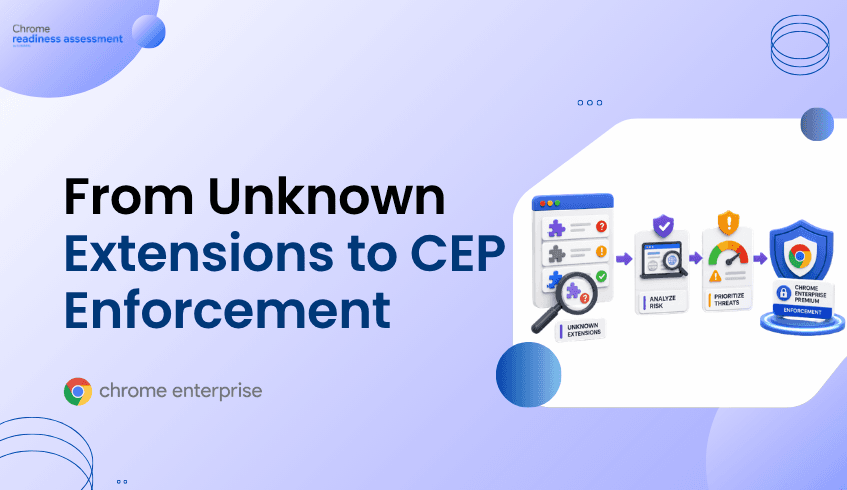
Unknown browser extensions can create serious policy blind spots for enterprise security teams. Extensions may request access to web pages, browser activity, cookies, downloads, or sensitive application data, making visibility essential before enforcement begins. Browser Insights helps security teams identify installed extensions, sources, permissions, and device-level exposure across the enterprise browser fleet. Chrome Enterprise Premium provides the browser-level enforcement layer, while CEP Accelerator helps teams prioritize which extension risks to address first.
Unknown extensions are risky because they operate inside the same browser environment where users access enterprise applications, cloud data, credentials, and authenticated sessions.
For users, extensions often feel harmless. They improve productivity, change browser behavior, summarize pages, manage passwords, capture screenshots, or automate workflows. But from a security perspective, every extension is also software running close to sensitive browser activity.
The risk depends on what the extension can access and where it came from. Some extensions request broad permissions. Some are installed from trusted marketplaces. Others may be installed through developer mode, sideloading, or less controlled paths. Some extensions may be legitimate today but become risky later through ownership changes, compromised updates, or overly broad access.
That is why enterprise teams cannot manage extension risk only by asking whether an extension looks useful. They need visibility into what is installed, where it is installed, what permissions it requests, and which users or devices are exposed.
Unknown extensions create policy blind spots when security teams do not have a clear inventory of browser add-ons across the fleet.
A security team may have strong endpoint controls, identity policies, and SaaS permissions. But if users can install extensions that interact with page content, browser activity, or web application data, the browser can become a gap between identity and data protection.
This matters because extensions can sit directly inside the user’s daily workflow. They may read page content, modify websites, interact with forms, capture information, or connect to third-party services. Even when an extension is not malicious, it can still create governance problems if it has excessive permissions or is not approved for enterprise use.
Google’s Chrome Enterprise extension management guidance highlights that admins can manage extensions based on the permissions they request, including blocking extensions that require permissions the organization does not allow.
The policy challenge is simple: teams cannot govern what they cannot see.
Extension risk is becoming harder to manage because browser work has expanded.
Employees now use the browser for SaaS applications, AI tools, developer platforms, finance systems, collaboration apps, customer data, and internal dashboards. At the same time, extensions are increasingly used to support productivity, automation, AI assistance, password workflows, data capture, and web customization.
That creates a wider attack surface.
A single unknown extension may not seem urgent. But across hundreds or thousands of devices, unknown extensions can become a distributed browser-layer risk. Some may have broad access. Some may be installed across multiple browsers. Some may appear only on a small number of high-value devices. Some may overlap with unsafe domain access or outdated browser versions.
Security teams need a way to separate routine extension usage from elevated risk. That starts with inventory and classification.
Traditional security tools often look at endpoint activity, identity events, network traffic, or application access. Those signals are important, but they do not always provide extension-specific context.
For extension governance, security teams need answers to practical browser questions:
Which extensions are installed across the fleet? Which browsers are they installed on? Are the extensions verified or unverified? What permissions are associated with them? Which devices have the highest extension exposure? Are unknown extensions appearing alongside other browser risks?
Without this browser-specific view, extension governance becomes reactive. Teams may only discover risky extensions after an incident, user report, audit finding, or policy violation.
A stronger approach is to identify extension exposure early, then use browser-level policy to reduce risk before it becomes part of an attack path.
Chrome Enterprise Premium helps organizations bring advanced security controls directly into the browser, where extension activity occurs.
For extension security, enforcement matters because extensions operate at the browser layer. Policies need to govern which extensions can run, which permissions are acceptable, and how browser activity is protected when users interact with enterprise applications and data.
Chrome Enterprise provides policy controls for extension management, including the ability to configure extension settings by extension ID, update URL, or default policy. Google’s ExtensionSettings policy allows administrators to define how extensions are managed across enterprise Chrome environments.
Organizations can also use Chrome Enterprise controls to allow, block, or force-install specific extensions, and to manage extension behavior based on permissions. These capabilities help security teams move from “we found unknown extensions” to “we can enforce which extensions are allowed to operate.”
Chrome Enterprise Premium also strengthens the broader browser security posture with threat protection, data protection, and secure enterprise browsing controls. That broader enforcement layer matters because extension risk often intersects with other browser risks, including unsafe domain access, phishing exposure, data movement, and session protection.
Browser Insights gives security teams device-level visibility into browser and extension risk across the enterprise fleet.
For extension governance, Browser Insights helps surface installed extensions across Chrome, Edge, Firefox, Vivaldi, Brave, and Opera. It provides browser and extension details that help teams understand where extension exposure exists, including installed extensions, related metadata, and security-relevant insights.
This matters because enterprise browser environments are rarely uniform. Some users work primarily in Chrome. Others may use Edge, Firefox, Brave, Vivaldi, or Opera. Some devices may have only approved extensions. Others may contain unverified extensions or extensions that require closer review.
Browser Insights helps security teams see those differences at the device level.
That makes extension risk more actionable. Instead of guessing which users may have risky browser add-ons, teams can identify specific devices where unknown or unverified extensions exist. They can then prioritize investigation based on the concentration of extension risk and its relationship to other browser signals.
CEP Accelerator helps teams move from browser visibility to deployment planning.
It acts as a planning and visibility layer inside Browser Insights. It does not enforce policies, detect attacks directly, or automate remediation. Instead, it helps map observed browser risks to relevant Chrome Enterprise Premium capabilities.
For unknown extensions, CEP Accelerator can help security teams connect findings such as unverified extensions, broad extension exposure, or device-level browser risk to the Chrome Enterprise Premium controls that support stronger extension governance.
This is valuable because not every extension finding has the same level of urgency. A device with unverified extensions and access to restricted or unsecured domains may deserve faster attention than a device with lower exposure. CEP Accelerator helps teams prioritize where Chrome Enterprise Premium enforcement can have the greatest impact.
The practical path starts with discovery.
First, teams need a clear inventory of installed extensions across the browser fleet. This includes understanding which extensions are present, which browsers they appear on, and which devices are affected.
Next, teams should review extension trust and permissions. Unknown or unverified extensions should be investigated, especially when they request broad access or appear on sensitive user devices.
Then, teams can define policy decisions. Some extensions may be approved. Some may need restrictions. Others may need to be blocked, removed, or replaced with managed alternatives.
Finally, security teams can use Chrome Enterprise policies and Chrome Enterprise Premium capabilities to enforce the desired browser posture. The goal is not to block every extension by default without business context. The goal is to create a managed extension environment where productivity tools can be used safely and risky extensions do not operate unchecked.
No. Unknown extensions are not always malicious. They may be legitimate tools that have not been reviewed or approved by the organization. The risk is that security teams do not yet know what they do, what permissions they require, or whether they meet enterprise policy.
Extension permissions matter because they define what an extension can access or change in the browser. Some permissions may allow an extension to interact with websites, browser activity, or sensitive data. This makes permission review essential for enterprise extension governance.
No. Browser Insights provides visibility into browser and extension risk. Enforcement is handled through browser management and Chrome Enterprise Premium controls.
Chrome Enterprise Premium supports stronger browser security by bringing advanced protection and management capabilities into the browser. Combined with Chrome Enterprise extension policies, organizations can manage which extensions are allowed, blocked, or controlled across enterprise environments.
CEP Accelerator helps teams prioritize Chrome Enterprise Premium deployment based on browser risks observed through Browser Insights. For extension risk, it helps connect unknown or unverified extension exposure to relevant browser security controls.
Unknown extensions create browser security blind spots because they operate where enterprise work happens: inside the browser. Start by using Browser Insights to identify unverified extensions, extension permissions, and affected devices across your fleet. Then use CEP Accelerator to prioritize where Chrome Enterprise Premium enforcement can help strengthen extension governance and reduce browser-layer risk.
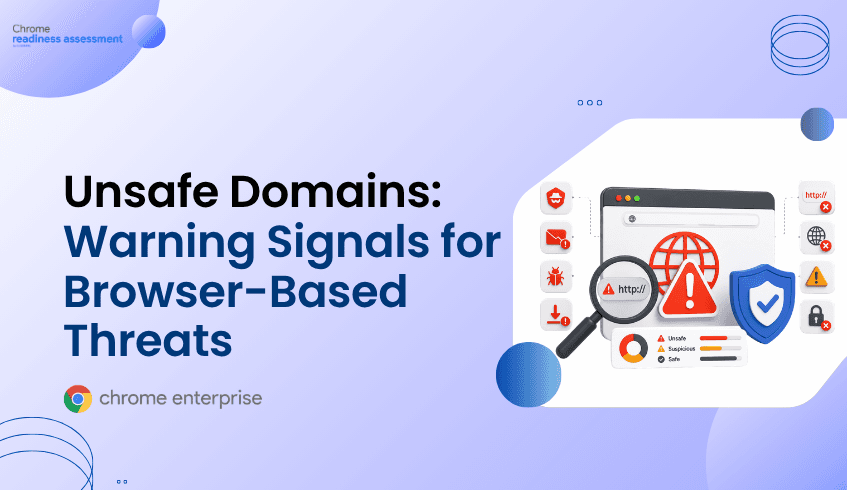
Unsafe domains are often one of the first visible signs of browser-based risk. A single visit to a suspicious, restricted, or non-HTTPS domain may not look like a major incident, but across an enterprise fleet, those visits can reveal patterns that security teams need to act on. Browser Insights helps teams identify where risky domain access is happening at the device level. Chrome Enterprise Premium provides browser-level controls that help reduce exposure, while CEP Accelerator helps teams prioritize where those controls should be deployed first.
Unsafe domains matter because the browser is where users interact with web apps, SaaS platforms, cloud data, internal tools, and identity sessions.
Attackers know this. They use phishing pages, lookalike domains, unsecured sites, malicious redirects, and compromised web infrastructure to reach users inside normal browsing workflows. The user may think they are visiting a routine website. The security team may only see a small web event. But the browser may now be exposed to credential theft, malware delivery, data loss, or session abuse.
That is why domain visibility has become an important browser security signal.
A domain visit is not just a destination. It can indicate whether users are reaching unsafe web infrastructure, whether policy controls are being bypassed, whether certain devices are repeatedly accessing risky locations, or whether a department is using tools that have not been reviewed.
This matters even more as enterprise work becomes increasingly browser-based. Chrome Enterprise Premium is designed to bring advanced enterprise security directly into the browser, including centralized management, threat protection, data protection, and Zero Trust access controls.
Unsafe domains become early warning signals when they reveal risky behavior before a larger incident occurs.
For example, a device that repeatedly accesses non-HTTPS domains may be exposed to weaker transport security. A user visiting suspicious domains may be interacting with phishing infrastructure. Access to company-restricted domains may indicate policy gaps or risky behavior that should be reviewed.
When those signals are seen across multiple devices, they become more than isolated browsing events. They become a browser posture issue.
The key is context.
Security teams need to know:
Which domains were accessed
Which devices accessed them
Whether the domains were unsecured, suspicious, or restricted
How often the access occurred
Whether risky domain access overlaps with other browser risks
Without that context, unsafe browsing activity can stay hidden until it becomes part of a larger attack chain.
Unsafe domains can support several common browser-based attack paths.
Phishing is the most obvious. Attackers use fake login pages, lookalike domains, and redirect chains to trick users into entering credentials or approving access. Even when MFA is enabled, phishing can still lead to session abuse if attackers target post-login tokens or trick users into interacting with malicious workflows.
Malware delivery is another major concern. Unsafe domains can host downloads, scripts, or redirects that lead users toward harmful files. Google Safe Browsing helps protect users by warning them before they visit dangerous sites or download harmful apps.
Unsafe domains can also contribute to data exposure. A user may upload sensitive content to an unapproved web service, paste information into a non-corporate tool, or interact with an unsecured website that does not meet enterprise policy requirements.
In each case, the domain visit is an early signal. It may not prove compromise, but it gives security teams a place to investigate before the risk expands.
Traditional controls often focus on identity, endpoint activity, or network events. Those controls are still important, but they may not provide the browser-specific detail security teams need.
An identity tool may confirm that a user successfully authenticated. An endpoint tool may show that the device is active. A firewall may log web traffic. But those signals may not clearly answer browser posture questions such as:
Is this device visiting restricted domains?
Is the browser reaching non-HTTPS sites?
Are risky domains concentrated on specific machines?
Are unsafe domains connected to extension or session exposure?
Browser-layer visibility helps close that gap. It shows risk in the place where web activity actually happens: inside the browser environment.
This is especially important for organizations with mixed browser fleets. Enterprise users may access work through Chrome, Edge, Firefox, Brave, Vivaldi, Opera, or other browsers. If security teams cannot see browser and domain behavior across the fleet, unsafe domain activity can remain fragmented and difficult to prioritize.
Chrome Enterprise Premium helps organizations enforce browser-level protections where web risk appears.
For unsafe domain exposure, this matters because the browser is the control point closest to the user’s web activity. Chrome Enterprise Premium builds on Chrome’s secure foundation with advanced enterprise protections, including threat protection, data protection, centralized management, and Zero Trust access controls for web applications.
That browser-level enforcement is important when users interact with phishing pages, malicious domains, risky web apps, or unauthorized destinations. Instead of relying only on controls that operate after the browsing event, Chrome Enterprise Premium helps organizations apply protection during the browsing experience.
Security teams can also use Chrome Enterprise policies and website access controls such as URL blocklists and allowlists to help manage which sites users can access in enterprise environments.
For security teams, the practical value is clear: unsafe domains are not only something to detect later. They are destinations where policy can be applied earlier.
Browser Insights helps security teams see where browser-level risk exists across the enterprise fleet.
For domain risk, Browser Insights surfaces accessed domains and helps identify unsecured, suspicious, or company-restricted domain activity. This gives IT and security teams a clearer view of which devices are reaching unsafe or restricted destinations.
That visibility is especially useful because domain risk is rarely evenly distributed. One device may be accessing restricted domains regularly. Another may show unsecured domain activity. A third may combine unsafe domain access with other browser risks, such as unverified extensions or outdated browser versions.
Browser Insights supports device-level investigation, helping teams move from a broad organizational view into the specific machines where browser risk is elevated. This makes unsafe domain access easier to review, prioritize, and address.
The goal is not to treat every domain visit as an incident. The goal is to turn domain activity into a practical security signal.
CEP Accelerator helps teams move from visibility to prioritization.
It acts as a planning and visibility layer inside Browser Insights. It does not enforce policies or detect attacks directly. Instead, it helps connect observed browser risks to the Chrome Enterprise Premium capabilities that can help address them.
For unsafe domains, that means security teams can use Browser Insights to see where risky domain access exists, then use CEP Accelerator to understand which areas should be prioritized for Chrome Enterprise Premium deployment.
This is useful because browser risk is often spread across many devices, users, and departments. CEP Accelerator helps teams avoid treating every finding equally. A device with restricted domain access, unsecured browsing activity, and other browser risk indicators may deserve faster attention than a device with lower exposure.
Security teams should treat unsafe domain access as an indicator of browser posture, not just a web traffic event.
A single unsafe domain visit may be accidental. A pattern of unsafe domain access across multiple devices may indicate a broader policy or visibility problem. Repeated access to restricted domains may suggest that existing controls are not aligned with real user behavior. Non-HTTPS domain activity may highlight weak browsing hygiene. Suspicious domains may reveal phishing or malware exposure.
The most important shift is to connect domain visibility with action.
Browser Insights shows where the exposure exists. Chrome Enterprise Premium provides enforcement capabilities that help reduce browser-based risk. CEP Accelerator helps prioritize the path from discovery to deployment.
That combination gives security teams a practical way to move from “we saw risky browsing” to “we know which devices are exposed and which browser controls should come next.”
No. An unsafe domain signal does not always mean the domain is malicious. It means the domain may require review because it is unsecured, suspicious, restricted by company policy, or associated with risky browsing behavior.
Non-HTTPS domains can create weaker security conditions for browser activity. They may expose users to unsafe redirects, interception risk, or lower-trust browsing experiences, especially when accessed from enterprise devices.
Browser Insights is a visibility layer. It helps teams identify browser and domain risk across devices. Enforcement decisions are handled through browser security controls such as those available with Chrome Enterprise Premium.
Chrome Enterprise Premium brings advanced security controls directly into the browser, including threat protection, data protection, and access controls for web applications. This helps organizations reduce exposure where risky browsing activity occurs.
CEP Accelerator helps teams prioritize Chrome Enterprise Premium deployment based on browser risks observed through Browser Insights. It connects visibility to planning so security teams can decide where to act first.
Unsafe domains are often the first visible sign of browser risk. Start by using Browser Insights to identify which devices are accessing unsecured, suspicious, or restricted domains. Then use CEP Accelerator to prioritize where Chrome Enterprise Premium can help strengthen browser-level protection across the enterprise fleet.
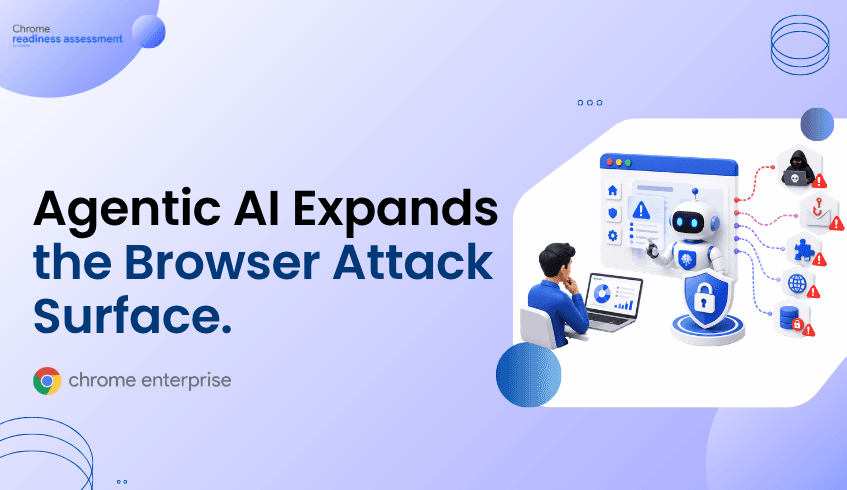
Google I/O 2026 made one thing clear: AI is moving from passive assistance to agentic workflows that can take action across enterprise tools, web apps, and data sources. That shift makes the browser a more important security boundary because many agentic workflows interact with enterprise systems through authenticated browser sessions. Browser Insights helps security teams understand browser, extension, session, and domain risk across the fleet. Chrome Enterprise Premium provides browser-level security controls, while CEP Accelerator helps teams prioritize which risks to address first.
Agentic AI changes browser security because AI systems are increasingly able to browse, read, summarize, create, and act across enterprise workflows.
At Google I/O 2026, Google Cloud highlighted new AI innovations for the “Agentic Enterprise,” including Gemini Enterprise, Agent Platform, Workspace AI features, Antigravity, Managed Agents API, Gemini Spark, and CodeMender. These capabilities reflect a larger shift: AI is becoming more action-oriented, more connected to business systems, and more embedded in daily work.
That matters for security teams because the browser is often where this work happens.
Employees use browsers to access Workspace, SaaS platforms, cloud consoles, developer tools, customer systems, internal dashboards, and AI applications. Once users authenticate, the browser becomes the place where session context, sensitive data access, extensions, and web content intersect.
The risk is not that agentic AI is inherently unsafe. The risk is that agentic AI increases the importance of browser posture. If a device is running an outdated browser, has unverified extensions installed, or regularly accesses risky domains, AI-driven workflows may operate inside an already exposed environment.
AI agents can expand the browser attack surface by increasing the amount of automated activity that takes place inside authenticated web sessions.
Traditional browser activity is usually human-driven. A user clicks a link, opens a document, signs in to an app, downloads a file, or copies data between systems. Agentic workflows can compress many of those actions into a single automated task. An agent may read a document, search the web, interact with a SaaS app, summarize results, draft content, or prepare an update across connected tools.
That creates new questions for IT and security teams:
Is the browser version current?
Are risky extensions installed?
Are users accessing unsecured or restricted domains?
Which devices may be exposed to session theft risk?
Which browser environments are ready for AI-enabled workflows, and which are not?
Without browser-level visibility, these questions are difficult to answer. Security teams may know which identity provider is in use. They may know which endpoints are managed. They may even know which SaaS apps are approved. But they may still lack a clear view of the browser conditions where AI-assisted work is happening.
That is the visibility gap agentic AI makes harder to ignore.
Traditional controls can fall short because they often focus on login events, endpoint status, or network traffic rather than browser-specific risk.
Identity tools can confirm that a user authenticated successfully. Endpoint tools can report device health. Network tools can inspect traffic patterns. But browser risk often depends on more specific details:
An outdated browser may increase session theft exposure.
An unverified extension may introduce risk into the browsing environment.
A non-HTTPS or restricted domain may create unsafe browsing conditions.
A device may appear managed but still contain browser-level issues that matter for enterprise security.
This becomes more important in agentic workflows because agents may act inside the same browser context as the user. If browser posture is weak, agentic activity may inherit that weakness.
Security teams need a way to see browser-level risk before they scale AI-enabled workflows across the enterprise.
Chrome Enterprise Premium helps organizations apply advanced security directly within the browser, where web-based work happens.
Google describes Chrome Enterprise Premium as a secure enterprise browsing solution that builds on Chrome’s foundation with centralized management, threat and data protection, and Zero Trust access controls for web applications.
For agentic AI, this matters because the browser is not just a productivity tool. It is a security control point.
Chrome Enterprise Premium can help enterprises strengthen protection around phishing and malware, data movement, access to web applications, and browser-based policy enforcement. Google’s documentation also describes data protection rules for Chrome Enterprise Premium that can help monitor and control sensitive data actions in Chrome across supported desktop and ChromeOS environments.
That makes CEP relevant to AI-era security planning. As AI workflows become more connected to enterprise data and applications, organizations need stronger controls at the point of browsing.
Browser Insights helps security teams understand browser-level exposure across the enterprise fleet.
It gives teams visibility into browser and extension details across devices, including browser name, browser version, and installed extensions. It also supports visibility across multiple browsers, including Chrome, Edge, Firefox, Vivaldi, Brave, and Opera.
For agentic AI readiness, the most important signals include:
Session theft vulnerability based on browser version.
Unverified extensions.
Suspicious, restricted, or unsecured domain access.
Device-level security status.
Device-level drill-down for investigation.
This makes Browser Insights valuable because it helps teams identify the conditions that could increase risk before agentic workflows are widely adopted.
For example, a security team preparing for broader AI usage may want to know which devices are running outdated browsers, which users have unverified extensions installed, and which machines are accessing restricted or non-HTTPS domains. Browser Insights gives teams a way to surface those issues at both organization and device levels.
It does not need to detect an active AI attack to be useful. Its value is in showing where browser posture may already be weak.
CEP Accelerator helps teams move from browser visibility to prioritization.
Inside Browser Insights, CEP Accelerator acts as a planning and visibility layer. It helps connect observed browser risks to relevant Chrome Enterprise Premium capabilities so teams can better understand where CEP can reduce exposure.
This distinction is important. CEP Accelerator is not an enforcement tool. It does not automatically deploy Chrome Enterprise Premium, detect attacks in real time, or remediate incidents. Its role is to help security and IT teams interpret browser risk and prioritize action.
For agentic AI risk, this is especially useful. A team may see hundreds or thousands of browser findings across versions, extensions, and domains. CEP Accelerator can help bring structure to those findings by showing which risks are most relevant to CEP adoption and where browser-level security improvements may matter most.
Enterprises should evaluate browser readiness before scaling agentic AI across users, apps, and business workflows.
That does not mean slowing AI adoption. It means making AI adoption safer by understanding the browser environment first.
A practical readiness model starts with visibility. Security teams should know which browsers are in use, which versions are outdated, which extensions are installed, and which devices are accessing risky domains. From there, they can prioritize browser security improvements and align them with broader Chrome Enterprise Premium planning.
This approach creates a cleaner path:
Browser Insights identifies browser-level risk.
Chrome Enterprise Premium provides browser-level security controls.
CEP Accelerator helps prioritize where those controls are most relevant.
Together, they help enterprises treat browser readiness as part of AI readiness.
Agentic AI browser security focuses on protecting the browser environments where AI agents and AI-assisted workflows interact with web apps, SaaS platforms, enterprise data, and user sessions.
No. Browser Insights should be understood as a visibility layer for browser risk, not an active attack detection tool. It helps teams identify exposure conditions such as outdated browsers, unverified extensions, and risky domain access.
Browser extensions matter because they can affect what happens inside the browsing environment. Unverified or risky extensions may increase exposure when users or AI workflows interact with enterprise apps and web content.
Chrome Enterprise Premium helps by applying advanced security controls directly within the browser, including centralized management, threat and data protection, and Zero Trust access controls for web applications.
CEP Accelerator helps map browser risks surfaced through Browser Insights to relevant Chrome Enterprise Premium capabilities. It supports planning and prioritization, not direct enforcement or real-time threat detection.
Agentic AI is moving quickly into enterprise work. Before those workflows scale across users, apps, and data, security teams need to understand whether the browser fleet is ready.
Start with Browser Insights to identify browser, extension, session, and domain risk across your environment. Then use CEP Accelerator to prioritize where Chrome Enterprise Premium can help strengthen browser security for the agentic AI era.
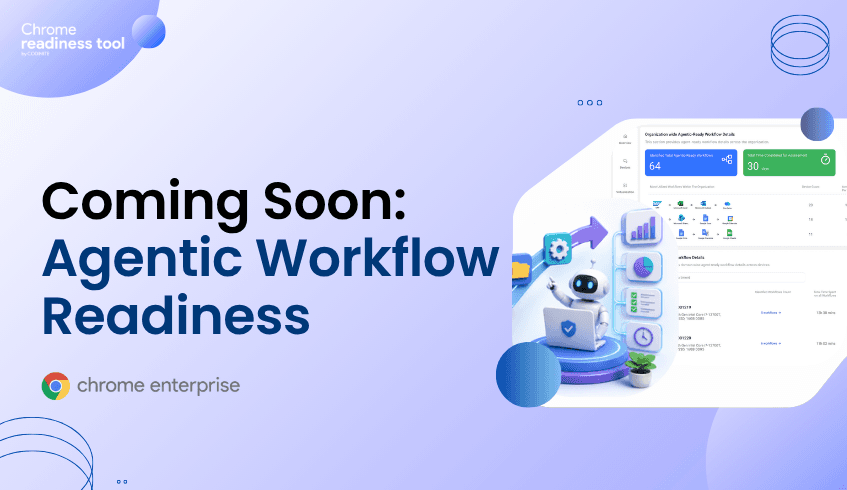
Enterprise teams know repetitive work is slowing them down, but most organizations do not know which workflows should be automated first. Manual processes often span email, spreadsheets, documents, calendars, SaaS tools, and internal applications, making them hard to measure and even harder to prioritize. Agentic Workflow Readiness in Chrome Readiness Assessment helps close that gap by surfacing repetitive, multi-step workflows and identifying where AI-driven automation can create the most business value. It helps teams move from guessing about automation opportunities to planning with real usage insight.
The problem is not a lack of automation tools. The problem is knowing where to apply them.
Most enterprises already have teams experimenting with AI agents, workflow automation, scripts, and no-code tools. But without visibility into how work actually happens across devices and applications, automation becomes fragmented. One team may automate a task that saves minutes, while a larger, more repetitive process remains untouched.
This creates several business pain points:
Manual workflows continue to consume employee time.
Operations teams struggle to identify high-impact automation opportunities.
IT teams lack a clear view of which applications are involved in recurring workflows.
Business leaders cannot easily estimate where automation will reduce cost or improve efficiency.
Automation decisions are often based on assumptions instead of real usage patterns.
As organizations move toward agentic AI, this visibility gap becomes more important. AI agents can automate complex work, but only when the organization understands which workflows are repeatable, frequent, and technically feasible to automate.
Chrome Readiness Assessment helps organizations move from uncertainty to visibility.
Before teams invest in AI agents or automation platforms, they need to understand how work is actually happening across the enterprise. Which workflows are repeated every day? Which ones consume the most time? Which applications are involved? Which processes are good candidates for automation?
The Agentic Workflow Readiness feature expands the value of Chrome Readiness Assessment by giving IT and business leaders a clearer view of repetitive, multi-step workflows across devices and applications.
Instead of relying on manual interviews, assumptions, or scattered process documentation, CRA helps surface workflow patterns from real application usage. It identifies recurring sequences across desktop and browser-based activity, highlights time spent on those workflows, and shows which workflows may be ready for automation.
This makes CRA a practical starting point for agentic AI adoption.
With CRA, organizations can:
Discover repetitive workflows across users and devices.
Understand where employees spend time on manual processes.
Identify high-impact workflows based on frequency and time spent.
See whether workflows are better suited for Google Workspace Studio, n8n, or both.
Prioritize automation opportunities before committing implementation resources.
The key benefit is clarity. CRA does not automate workflows directly. It helps organizations understand where automation can deliver value, which workflows are feasible, and which automation path may be most appropriate.
That turns Chrome Readiness Assessment from a readiness tool into a strategic automation planning layer. It helps leaders answer the question that often blocks AI adoption: Where should we automate first?
Agentic Workflow Readiness does not automate workflows directly. It helps organizations identify and plan the right automation path.
For workflows centered around Google Workspace applications such as Gmail, Drive, Calendar, and related Workspace activity, Google Workspace Studio is positioned as a natural automation path. Google describes Workspace Studio as a way to automate work with Gemini-powered workflows and create AI agents for Workspace processes.
For workflows that span multiple applications, SaaS platforms, or integration-heavy environments, n8n can support broader workflow automation. n8n describes itself as a workflow automation platform that combines AI capabilities with business process automation and supports a large ecosystem of integrations.
This distinction helps teams avoid a common automation mistake: choosing a tool first and searching for use cases later. Agentic Workflow Readiness reverses that approach. It starts with real workflow behavior, then helps map the workflow to a suitable automation option.
AI agents are powerful, but they need the right operating context.
Without workflow visibility, organizations may automate isolated tasks while missing the bigger process. They may also underestimate integration complexity, duplicate automation work across teams, or invest in automations that do not address meaningful business pain.
Agentic Workflow Readiness helps create that missing context. It gives decision-makers a clearer understanding of how work moves across applications and where repeatable patterns exist.
This is especially useful for:
IT leaders evaluating where agentic automation should begin.
Operations teams looking to reduce repetitive manual effort.
Business leaders seeking cost optimization opportunities.
Transformation teams building an AI automation roadmap.
Security and governance stakeholders who need visibility before automation expands.
The result is a more disciplined path to agentic AI adoption. Teams can identify what is ready, understand which workflows are worth prioritizing, and choose automation technologies with greater confidence.
Operational cost is not only about software spend. It is also about the time employees spend repeating the same multi-step processes every day.
When repetitive workflows remain manual, organizations absorb hidden costs through slower execution, duplicated effort, avoidable handoffs, and inconsistent process quality. These costs are difficult to manage when leaders cannot see where the time is going.
Agentic Workflow Readiness helps make those costs visible by showing where repetitive workflows exist and how much time they consume. That visibility allows teams to prioritize automation where it can reduce manual effort and improve process efficiency.
The business impact is practical:
Employees spend less time on repetitive coordination.
Teams can focus automation resources on high-value workflows.
Leaders gain a clearer view of where manual work is creating drag.
IT can plan automation adoption with better evidence.
Organizations can move toward agent-driven operations without relying on guesswork.
Traditional workflow audits are often manual, slow, and incomplete. They rely on interviews, surveys, workshops, or process documentation that may not reflect how work actually happens.
Agentic Workflow Readiness is designed to support a more usage-informed approach. It analyzes workflow patterns across desktop and browser-based activity, including web application usage, to identify repeatable sequences and automation opportunities.
That makes it more practical for modern enterprises, where workflows often span local applications, browser-based SaaS tools, and Google Workspace applications.
Instead of asking, “What do teams say they do every day?” organizations can begin asking, “Which workflows are repeatedly happening across our environment, and which ones are ready for automation?”
Organizations should view Agentic Workflow Readiness as a planning and visibility capability for automation strategy.
It is not a tool for automatically deploying agents. It is not real-time orchestration. It does not create custom workflows on behalf of users. Its role is to help administrators and decision-makers identify automation-ready workflows and understand where tools like Google Workspace Studio or n8n may fit.
That makes it especially valuable at the beginning of an automation journey. Before scaling agentic AI, organizations need to know where automation makes sense. Agentic Workflow Readiness gives them a clearer way to make that decision.
Agentic Workflow Readiness is a Chrome Readiness Assessment feature that helps organizations identify repetitive workflows that may be suitable for AI-driven automation.
No. It helps identify and recommend automation opportunities, but it does not execute, deploy, or orchestrate workflows automatically.
It helps map automation opportunities to Google Workspace Studio for Google ecosystem workflows and n8n for cross-application or integration-heavy workflows.
IT admins, operations leaders, transformation teams, and business decision-makers benefit because the feature helps them prioritize automation based on real workflow patterns.
Agentic AI works best when organizations know which workflows are repetitive, valuable, and feasible to automate. Agentic Workflow Readiness helps provide that foundation.
Manual work is often hidden inside everyday application usage. Agentic Workflow Readiness helps bring that work into view, so organizations can identify high-impact automation opportunities before investing time and resources into AI agents.
Start by using Chrome Readiness Assessment to understand where repetitive workflows exist across your environment. Then use those insights to prioritize the workflows best suited for Google Workspace Studio, n8n, or future agentic automation initiatives.
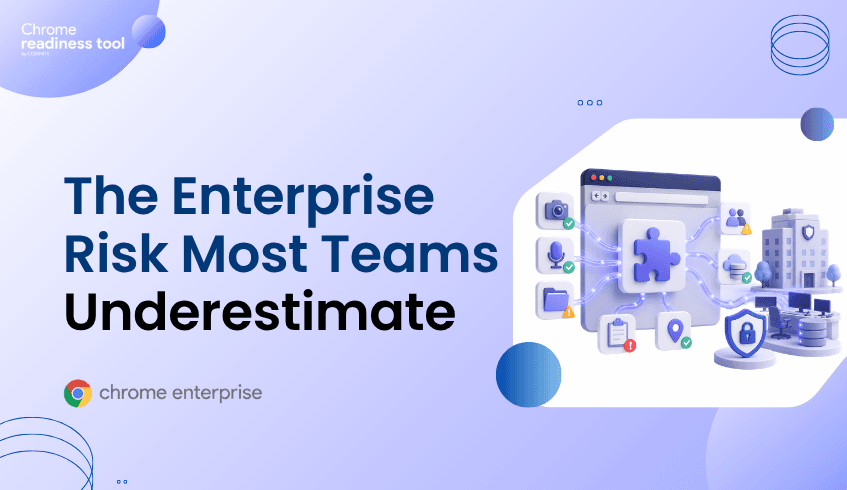
Browser extensions can improve productivity, but their permissions can also create enterprise security risk. Extensions may request access to webpages, browsing activity, data, or browser functionality that security teams do not fully understand.
In an enterprise environment, extension risk is not just about whether an extension is installed. It is about what the extension can access, where it came from, and which devices are affected.
Browser Insights helps surface extension visibility, Chrome Enterprise Premium supports stronger browser protection, and CEP Accelerator helps teams prioritize extension-related risk.
Extension permissions matter because they define what an extension can do inside the browser.
Some extensions need limited access to function properly. Others may request broader permissions, such as the ability to read or modify site data, interact with webpages, or access browsing context. Google’s Chrome Enterprise guidance explains that admins can manage extensions based on the information an extension can access, also known as Chrome app and extension permissions.
In a consumer setting, this may be an individual privacy concern. In an enterprise setting, it becomes a security issue because users access sensitive systems through the browser.
Employees use the browser to reach SaaS applications, internal dashboards, finance platforms, customer systems, developer tools, and AI applications. If an extension has broad permissions inside that browser, it may increase exposure to sensitive application data, session context, or user activity.
That does not mean every extension with broad permissions is malicious. It means security teams need a clear way to understand what extensions can access and whether that access is appropriate for the enterprise environment.
Extension risk is hard to manage because extensions are often installed for legitimate reasons.
Employees may install productivity tools, meeting helpers, password utilities, AI assistants, shopping tools, PDF tools, or developer extensions. Some may come from trusted stores. Others may be installed through developer mode or less controlled sources.
The challenge is that security teams may not have a complete view of:
Which extensions are installed
Which browsers they are installed on
Which devices are affected
What permissions the extensions request
Whether the extensions are verified
Whether installation sources align with company policy
Without that visibility, extension governance becomes reactive.
Google’s official guide for Managing Extensions in Your Enterprise recommends evaluating extensions based on the permissions they request and managing them through enterprise controls. That is the right foundation, but teams still need visibility into what is already installed across the fleet before they can prioritize action.
Traditional endpoint tools may show installed applications or malware alerts, but browser extensions operate inside the browser environment.
An extension may not look like a traditional executable. It may not generate a high-confidence malware alert. It may simply sit inside the browser with access that is broader than the organization would normally allow.
This creates a browser-layer blind spot.
Security teams need extension-specific visibility because extension risk depends on browser context, permissions, installation source, and device-level exposure. A browser extension installed on one low-risk device may be a minor issue. The same extension installed across many devices with broad permissions may become a meaningful enterprise risk.
That is why extension security should not be treated as a one-time approval process. It needs ongoing inventory, review, policy, and governance.
Chrome Enterprise provides enterprise controls for managing browser extensions, including the ability to allow, block, or configure extension installation on managed Chrome browsers and ChromeOS devices.
Admins can allow or block apps and extensions, manage extension policies, and apply controls across users, browsers, or organizational units. Google also documents ways to set Chrome app and extension policies, including preventing users from running extensions that request permissions the organization does not allow.
This is important because extension security is not only about blocking known malicious extensions. It is also about reducing unnecessary permission exposure and ensuring that only approved extensions are used in enterprise browser environments.
A mature extension strategy should include visibility, review, policy, and ongoing governance. The goal is not to block every extension. The goal is to understand which extensions are necessary, which permissions are acceptable, and which devices may need attention.
Chrome Enterprise Premium helps organizations strengthen security where extensions operate: inside the browser.
Google describes Chrome Enterprise Premium as a secure enterprise browsing solution that helps protect corporate data in the browser. Google Cloud documentation also describes Chrome Enterprise Premium as enhancing Chrome’s built-in enterprise security with capabilities such as configurable data loss prevention, threat protection, and secure enterprise browsing controls through its Chrome Enterprise Premium overview.
For extension-related risk, this matters because risky extensions may contribute to unsafe browsing, data exposure, or session risk. Browser-level controls help organizations reduce exposure closer to the point where web activity and application access occur.
Chrome Enterprise Premium should be viewed as part of a broader browser security strategy that includes extension inventory, governance, and enforcement. It helps security teams bring protection closer to the browser session, where users interact with enterprise applications and sensitive data every day.
Browser Insights helps security teams understand extension exposure across enterprise devices.
It can surface installed extensions, extension metadata, permissions, installation source, installed browsers, and security or permission insights. It also helps identify unverified extensions and shows where they appear across the fleet.
This gives teams a practical way to answer high-value questions:
Which extensions are installed most often?
Which devices have unverified extensions?
Which extensions request sensitive permissions?
Which browsers are affected?
Which devices require investigation?
This turns extension visibility into a security workflow.
Instead of relying on individual user reports or manual browser checks, security teams can assess extension exposure across the environment and focus attention on the devices, browsers, and extensions that create the highest risk.
CEP Accelerator helps teams prioritize extension-related risk.
It does not enforce extension policies or detect extension attacks directly. Instead, it maps observed extension risks in Browser Insights to relevant Chrome Enterprise Premium capabilities.
For extension permissions, CEP Accelerator can help security teams understand which extension findings should drive CEP planning and which devices may need attention first.
This is especially useful when organizations have many installed extensions across many devices. Not every extension issue carries the same level of risk. CEP Accelerator helps teams focus on the exposures most relevant to browser security posture.
For example, a device with unverified extensions, broad permissions, and risky browsing activity may deserve more urgent review than a device with only low-risk approved extensions. CEP Accelerator helps turn browser visibility into a prioritized plan for reducing exposure.
Extension permissions define what an extension can access or modify inside the browser. Broad permissions may increase exposure to sensitive data, browsing activity, or enterprise application context.
No. Unverified does not automatically mean malicious. But unverified extensions can represent increased risk and should be reviewed by security or IT teams.
Teams should review the extension’s purpose, permissions, installation source, update behavior, affected users, and whether it aligns with company policy. Google’s enterprise guidance for managing extensions is a useful starting point for building that review process.
No. Browser Insights provides visibility into extension risk. Enforcement and policy actions should be handled through appropriate browser management and security controls.
CEP Accelerator helps map observed extension risks to relevant Chrome Enterprise Premium capabilities so teams can prioritize their browser security strategy.
Extension permissions are easy to underestimate because extensions often look like small productivity tools. But inside the enterprise browser, they can create meaningful exposure.
Use Browser Insights to identify unverified extensions, permissions, installation sources, and affected devices. Then use CEP Accelerator to prioritize the Chrome Enterprise Premium controls that can help reduce browser-layer risk.
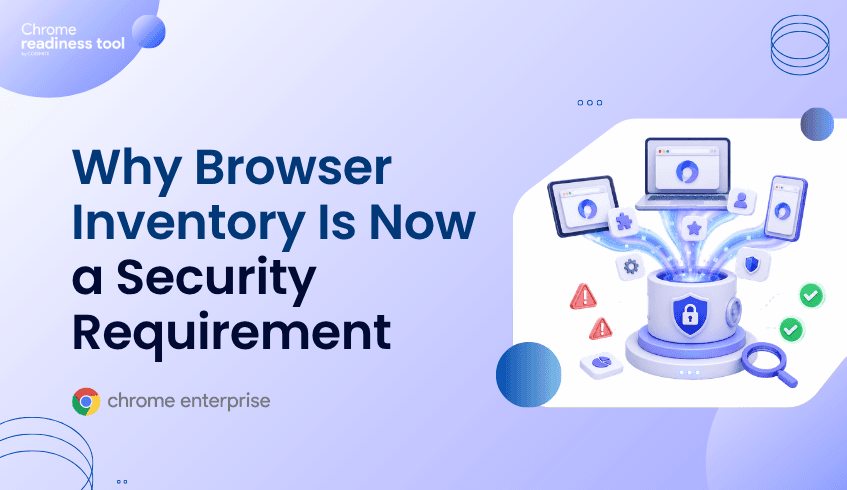
Browser inventory is no longer just an IT operations task. It is now a security requirement. Enterprises need to know which browsers are installed, which versions are running, which extensions are present, and which devices are accessing risky domains. Browser Insights provides device-level browser visibility, Chrome Enterprise Premium helps enforce stronger browser security, and CEP Accelerator helps prioritize action based on observed risk.
Browser inventory matters because the browser has become the front door to enterprise applications and data.
Users access email, identity systems, SaaS platforms, finance applications, customer records, developer tools, and AI services through the browser. If security teams do not know which browsers are in use or how they are configured, they cannot fully understand enterprise exposure.
An incomplete browser inventory creates basic but serious questions:
Which devices are running outdated browsers?
Which users have unverified extensions installed?
Which browsers are accessing restricted domains?
Which devices have the highest browser-level risk?
Without answers, browser security becomes guesswork.
A useful browser inventory should go beyond browser name.
Security teams need browser data that helps them assess risk. That includes browser version, installed extensions, extension metadata, domain access, and device-level security status.
At minimum, browser inventory should help answer:
What browsers are installed across the fleet?
What versions are running?
Which extensions are installed?
Which extensions are unverified?
Which devices are accessing unsafe domains?
Which devices are considered secure or not secure?
Which devices require investigation?
This turns inventory into security intelligence.
Most enterprises do not have a single-browser environment.
Users may run Chrome, Edge, Firefox, Brave, Opera, Vivaldi, or other browsers depending on role, device, preference, or legacy application requirements. Browser diversity is not automatically bad, but unmanaged diversity can create visibility gaps.
A security team may have strong controls for one browser while lacking visibility into others. That gap can make it difficult to understand where outdated versions, unverified extensions, or unsafe browsing activity exist.
Browser inventory helps normalize that view across the fleet.
Chrome Enterprise Premium is not simply about knowing what browsers exist. It is about applying stronger controls where browser-based work and risk happen.
Google describes Chrome Enterprise Premium as enhancing Chrome’s enterprise security with secure enterprise browsing capabilities, including threat and data protection and access controls.
Inventory gives teams the starting point. Chrome Enterprise Premium gives them browser-level controls to reduce exposure once risk is identified.
That combination is important. Without inventory, teams may not know where controls are needed most. Without enforcement, inventory alone cannot reduce risk.
Browser Insights helps organizations build practical browser inventory across the enterprise fleet.
It surfaces browser and extension details at the device level, including browser name, browser version, and installed extensions. It also highlights security-related signals such as session theft vulnerability, unverified extensions, and risky domain access.
This matters because browser inventory becomes actionable only when it connects to risk.
For example, knowing that a device has Chrome installed is useful. Knowing that the device has an outdated browser version, unverified extensions, and restricted domain access is much more useful.
CEP Accelerator helps convert browser inventory into a prioritized security plan.
It works inside Browser Insights as a planning and visibility layer. It does not deploy Chrome Enterprise Premium automatically, enforce browser policies, or remediate issues directly.
Instead, CEP Accelerator maps observed risks to relevant Chrome Enterprise Premium capabilities. This helps teams understand where CEP can reduce exposure and which devices or risk categories should be prioritized first.
For browser inventory, this means teams can move beyond a static list of browsers and toward a risk-informed deployment plan.
Browser inventory is the process of identifying browsers, versions, extensions, and related browser activity across enterprise devices.
Browser inventory helps security teams identify outdated browsers, risky extensions, unsafe domain access, and device-level exposure.
No. Enterprises often use multiple browsers. Browser inventory is most valuable when it provides visibility across the broader browser fleet.
No. Browser Insights provides browser and extension details along with security-related signals such as session theft vulnerability, unverified extensions, and risky domain access.
CEP Accelerator helps map browser risks found in Browser Insights to relevant Chrome Enterprise Premium capabilities so teams can prioritize action.
Browser inventory is now a foundation for enterprise browser security. Start by using Browser Insights to understand which browsers, versions, extensions, and domain risks exist across your fleet, then use CEP Accelerator to prioritize the Chrome Enterprise Premium controls that can help reduce exposure.
Device Bound Session Credentials are designed to reduce the impact of session cookie theft by making stolen session material harder to reuse from another device. This matters because attackers increasingly target authenticated browser sessions after users complete MFA. For enterprises, session protection requires both stronger browser security and better visibility into browser posture. Browser Insights helps identify session-related exposure, Chrome Enterprise Premium strengthens browser-level protection, and CEP Accelerator helps teams prioritize where to act first.
Session protection matters because attackers do not always need a password if they can steal an authenticated session.
In many attacks, the user signs in normally and completes MFA. After that, the browser receives session cookies or tokens that keep the user authenticated. If malware or another attack path steals that session material, an attacker may attempt to reuse it without repeating the original login process.
This is why session theft is so dangerous. It targets the browser after authentication has already succeeded.
Device Bound Session Credentials, or DBSC, are a Chrome security capability designed to make stolen session cookies less useful to attackers.
Google has described DBSC as a way to bind sessions to a device so that stolen cookies cannot simply be replayed from another machine. Google announced that DBSC is entering public availability for Windows users on Chrome 146, with macOS support planned for a future Chrome release.
The idea is straightforward: if a session is tied to the device where it was created, stealing the cookie alone becomes less valuable.
Session theft attacks bypass MFA by targeting the post-authentication session instead of the login process.
MFA protects the moment of authentication. But once a user completes MFA, the browser maintains the session so the user does not have to re-authenticate on every page load.
Attackers may use infostealer malware, malicious extensions, phishing flows, or compromised devices to obtain session cookies or tokens. Once stolen, those tokens may be replayed to access applications as the authenticated user.
This is not a failure of MFA. It is a reminder that authentication and session protection are different layers.
Device Bound Session Credentials are an important step forward, but browser posture still matters.
Enterprises still need to understand which devices are running current browser versions, which browsers are outdated, which extensions are installed, and where risky browsing activity is occurring.
DBSC helps reduce the usefulness of stolen session material. But security teams still need visibility into the conditions that increase session theft exposure, including outdated browsers and risky extensions.
That is where browser-level posture management becomes essential.
Chrome Enterprise Premium helps organizations strengthen security at the browser layer, where authenticated sessions live.
Google positions Chrome Enterprise Premium as a secure enterprise browsing solution that enhances Chrome’s built-in protections with capabilities such as threat protection, data protection, and access controls.
For session protection, this matters because many session theft paths begin with browser activity: phishing pages, unsafe domains, malicious downloads, or risky extensions.
Chrome Enterprise Premium helps organizations apply security closer to the session itself, instead of relying only on controls that operate before authentication or after compromise.
Browser Insights helps security teams see session-related browser exposure across the fleet.
One of the most relevant signals is session theft vulnerability based on browser version. Devices running outdated browser versions can be flagged as not protected, while devices running current versions can be shown as protected.
Browser Insights also surfaces installed extensions and domain access, which are important supporting signals for session risk.
A device with an outdated browser, unverified extensions, and unsafe domain access represents a higher-priority browser security concern than a device with current browser protection and no risky extension or domain activity.
CEP Accelerator helps teams prioritize session protection work.
It does not enforce policies or detect session theft directly. Instead, it maps observed Browser Insights risks to relevant Chrome Enterprise Premium capabilities.
For session protection, CEP Accelerator can help teams connect outdated browser versions, unverified extensions, and risky domain access to the controls that reduce browser-based session exposure.
This helps security teams focus on the devices and risks that matter most.
Device Bound Session Credentials are a Chrome security capability designed to bind sessions to a device, making stolen session cookies harder to reuse from another device.
No. DBSC does not replace MFA. MFA protects authentication, while DBSC helps strengthen the session after authentication.
Attackers steal session cookies because they can represent an already-authenticated browser session. If reused successfully, they may allow access without the user’s password or MFA prompt.
Browser Insights helps identify session theft vulnerability status based on browser version and provides related visibility into extensions and domain access.
No. CEP Accelerator is a planning and visibility layer. It helps map observed browser risks to relevant Chrome Enterprise Premium capabilities.
Enterprise session protection starts with knowing where session exposure exists. Use Browser Insights to identify outdated browsers, risky extensions, and unsafe domain access, then use CEP Accelerator to prioritize Chrome Enterprise Premium controls that help protect browser sessions.
Risky domains remain one of the clearest signals of browser-layer exposure. Non-HTTPS sites, suspicious domains, phishing destinations, and company-restricted domains can create pathways for credential theft, malware delivery, and data exposure. Security teams need visibility into which devices are accessing unsafe domains and how frequently that access occurs. Browser Insights helps surface domain-level risk, Chrome Enterprise Premium supports browser-level protection, and CEP Accelerator helps teams prioritize the right controls.
Risky domains matter because the browser is the first point of contact between users and the open web.
Even with strong endpoint security and identity controls, users may still visit unsafe sites, click phishing links, interact with suspicious pages, or access domains that do not meet company policy. These interactions happen inside the browser, often before other tools have enough context to respond.
Unsafe web access can contribute to several enterprise risks:
Credential phishing
Session theft
Malware delivery
Data leakage
Unauthorized access to restricted services
Exposure through non-HTTPS traffic
The issue is not only that risky domains exist. The issue is that many organizations do not know which devices are accessing them.
A risky domain is any web destination that creates security, privacy, or compliance concern for the organization.
This can include non-HTTPS domains, suspicious domains, phishing-related destinations, and company-restricted sites. In an enterprise environment, a domain may also be considered risky because it violates internal policy, even if it is not universally malicious.
For example, a company may restrict certain file-sharing services, unmanaged AI tools, or unauthorized SaaS applications. If devices continue accessing those domains, security teams need visibility into that behavior.
Many enterprise security tools focus on endpoint alerts, identity events, or network traffic. Those signals are valuable, but they may not provide a clean device-level view of browser domain exposure.
A network tool might show domain traffic. An endpoint tool might show malware activity. An identity tool might show sign-ins. But security teams still need to know:
Which browser accessed the domain?
Which device was involved?
Was the site non-HTTPS?
Was the domain restricted by company policy?
How many devices accessed it?
How much usage time was associated with the domain?
These are browser security posture questions. They require browser-level visibility.
Chrome Enterprise Premium helps organizations apply security controls directly within the browser, where risky web access occurs.
Google’s Chrome Enterprise Premium documentation describes capabilities for defending against real-time phishing and malware, preventing data exfiltration with DLP policies, and enforcing context-aware access to applications from Chrome.
For risky domain exposure, this matters because attackers often rely on malicious or suspicious destinations to host phishing pages, collect credentials, deliver payloads, or receive stolen data.
Browser-level protection helps reduce dependence on controls that only act after the user has already reached a risky destination.
Browser Insights helps security teams identify domain-related exposure across devices.
It can surface accessed domains and classify domain risk signals such as unsecured, suspicious, or company-restricted access. This gives teams visibility into where unsafe browsing behavior is occurring and which devices are involved.
Relevant domain insights include:
Domains accessed by users
Unsecured or suspicious domains
Admin-defined restricted domains
Number of devices accessing the domain
Device-level drill-down for investigation
This makes risky domain visibility more actionable. Instead of only knowing that a domain was accessed somewhere in the environment, teams can identify affected devices and prioritize response.
CEP Accelerator helps connect risky domain findings to relevant Chrome Enterprise Premium capabilities.
For risky domain exposure, CEP Accelerator can help teams prioritize controls related to safer browsing, URL filtering, phishing protection, and browser-level enforcement.
This helps security teams move from “we have risky domain activity” to “these are the devices and controls we should prioritize first.”
Risky domains can be used for phishing, malware delivery, credential theft, session theft, and data exfiltration. Because users access them through the browser, they are a browser-layer security concern.
A restricted domain is a web destination that an organization has defined as unsafe, unauthorized, or not allowed under company policy.
No. But non-HTTPS access can create additional risk because traffic is not protected in the same way as HTTPS traffic. In enterprise environments, it is a useful browser posture signal.
No. Browser Insights provides visibility into risky domain access. Chrome Enterprise Premium provides browser-level controls that can help reduce unsafe web access exposure.
CEP Accelerator maps observed risky domain exposure to relevant Chrome Enterprise Premium capabilities, helping teams prioritize deployment and policy planning.
Risky domains remain a practical signal of browser exposure. Start by using Browser Insights to identify which devices are accessing unsafe or restricted domains, then use CEP Accelerator to prioritize Chrome Enterprise Premium controls that can help reduce web access risk.